Sunday, March 15, 2020

Session 14: A Hard Fight

Wigand and Ludwig made their way into the outhouse. As they entered the courtyard, they noticed a guard patrolling the inner grounds. When Wigand made his way back to indicate to the others that the coast was clear, he made noise which was noticed by the guard. The man made his way into the storage area, where a fight broke out with Ludwig. The man tried to raise the alarm, but was subdued by Ludwig and Wigand.
Once everyone had entered the mansion, the searched the other buildings, finding all the guards sound asleep next to the keg of beer that had been spiked.
They entered the main building working their way up from the ground floor. As soon as they had walked up the stairs to the first floor, a fight broke out with a guard and his dog. This time the alarm was raised and upstairs they could hear a lot of sounds.
After overcoming the guard, it was decided they weren't going to fight their way up, but rather wait and set up a barricade near the staircase. Ludwig and Wigand made their way outside and, after a few failed attempts, were able to climb up and enter the rooms above. They saw a fully armoured man leave through the door and found 2 women in a corner next to the bed, who clearly had been assaulted before. 
The fight got ugly really quickly, as 6 experienced warriors in full plate got stuck into Lothar, Gotwin and Christina. Up on the stairs, Wigand had been able to trip Magnus Greel, and he was trying to take the leader out with the help of Ludwig.
The group downstairs was relatively successful, but Gotwin got badly wounded at the leg, and passed out. On the stairs, Wigand was knocked senseless too, and Ludwig was able to run Magnus through, but not before the witch hunter hit him with a final retaliatory strike, which took the dilettante out of the fight.
They woke up, 2 days later, having been bandaged. When they joined the rest of their party, it became clear that it had been a very close call. In the meantime, Katrin Antonescu had taken it upon herself to organise their move to nearby Pskoi, where a priest of Verena would be legally able to support her claim to her title. Lothar and his retinue were expected to accompany her.
The group took their time to go through the belongings of the defeated witch hunters, helping themselves to their armour, horses, papers (and in Wigand's case to Magnus Greel's head).
The next day, they leave at dawn, heading east.

Saturday, March 7, 2020

Garderike


Kislev

Kislev

Katrin Antonescu.

The rightful heir of the barony usurped by Baron Heinrich Von Weide, saved by the party from the clutches of Magnus Greel and his cronies.

Levan Rebrov

Levan Rubrov, a pedlar, who fills Wigand and Ludwig in on the recent state of affairs in the area of Kulm, Garderike (session 13).
The family owning this Barony is that of Antonescu. However the Baron died last year, and was succeeded by Heinrich von Weide, a minor third son from somewhere in the Ostland border marches. At the same time, it is readily admitted that there was a daughter to inherit, Katrin Antonescu.

He whispered that the rightful heir was kidnapped by Heinrich von Weide and is being held in a fortified small manor to the south-east (about a day’s travel). He believes that she can be rescued and escorted to safety in the village of Pskoi, which is situated in the lands of Governor Dmitri Khuzov. There is a priest of Verena located in the village who can grant her the right of eagrel and so enforce her rights to her title and lands. He assures them that both she and the Governor would be grateful and that most of the locals, including the militia, would welcome her back, but that Heinrich von Weide and his imported thugs are too powerful. They are ex-witch-hunters from The Empire he brought with him at the Count von Wallenstein’s instruction to further certain land claims the count had with his neighbours.

Session 13: A Damsel in Distress!


The group arrives before nightfall at Rheiden. This village is far more imposing than any of those that they have seen so far within Kislev. Its wooden rampart is well maintained and the ditch clear. In  addition the gatehouse flies the flags of the Imperial griffon, in addition to the Kislevite bear and that of a white eagle on a red background. Gotwin recognised the latter as the standard of Count Pleskai  von Wallenstein, marcher lord of the eastern Ostland border marches, but who principally resides in  Bechafen in the League of Ostermark. The squire also made sure to visit the blacksmith, in order to repair his armour (and to take advantage to tell the heroic story of how it got damaged and how he killed a Hellspawn a few days before)

The garrison is a mixed Empire and Kislevite one, as is the population. However, Reikspiel appears to be the more common tongue in the village.  In addition to an inn (The Weary Imperialist), there is a small wooden temple to the Imperial pantheon with primary place to Sigmar. The local priests are a cleric of Sigmar and a Kislevite initiate of Mórr, but an informal network of local deities has its own
tolerated priesthood. Castian visited the temple, and had a talk to the local priest. Ludwig and Wigand, organised the accomodation.

That night in the inn, they are confronted by two witch hunters, who want to have a word to Gotwin about this "Hellspawn" they've heard about, but soon change their attention to Christina, who they seem to know (and call a "Goodie-two-shoes"...). The situation gets diffused before it gets out of hand, but it is clear that the locals are terrified. Asking around, reveals that the two served with Magnus Greel, whom the group has heard being named the Butcher of Brizban, and villagers can confirm that the Baron employs Magnus.
Other gossip and rumours include:
  • The Professor and his three (male) companions stayed in the village on the night of the 15th Jahrdrung and continued along the road.
  • Kislev is fighting for its survival in the Chaos Wars. Constant fighting up north against invaders has been continuing for centuries. The south simply lets us carry on the struggle alone.
  • Governor Khuzov has requested that the Tsar send him a detachment of the Sons of Ursa. These are knights mounted on giant bears, who live in a fortress monastery to the east. What would the Governor want with them?
  • Governor Khuzov has fallen out with the Cult of Ulric. He is trying to import worship of his own, Lawful, deities. His private chaplain is attempting to alter traditional burial practices, claiming that they are ‘unclean’.
The next morning they have a strange meeting on the road further eastwards. A bowlegged cavalryman, dressed in heavy armour, with a spiked fur-trimmed helmet and a chainmail veil hiding his features approached them on foot out of the forest,  with his hand held up in a gesture of peace. He will politely inquire of their business and their authorization. Ludwig is able to talk to him in Kislevite, and the man explain there are a few issues with their paperwork. He eventually introduces himself as Tervel. After a few minutes he returns into the woods, and the group fears an ambush. Ludwig swears he has seen at least one large wolf in the wood, but noone else has seen this.

They find Kulm later in the afternoon, which is a protected village, featuring an inn (The von Wallenstein), an imposing wooden temple jointly to Sigmar and Uric (a most unusual thing) and a second to other Empire gods, and a small manor house. Both the gatehouse and the manor fly the flags of the Empire griffon, the Kislevite bear, a white eagle on a red background and a white twotailed lion rampant on a red field. This latter is unknown to the party. Like Rheiden,
Kulm appears to be a well-managed village consisting of a mixed Imperial and Kislevite
population.
They try to introduce themselves at the manor, but are being told by the (Imperial) servant, that Baron Heinrich Von Weide is absent, and as a result, they wont be able to see him. The servant does organize for them to stay in the Von Wallenstein, as guests of the Baron.
The best rooms and a lavish meal are organised, and the party is able to finally get a good and well deserved rest.
During the night, Wigand is approached by a local, who introduces himself as Levan Rubrov, a pedlar, who fills Wigand and Ludwig in on the recent state of affairs: the family owning this Barony is that of Antonescu. However the Baron died last year, and was succeeded by Heinrich von Weide, a minor third son from somewhere in the Ostland border marches. At the same time, it is readily admitted that there was a daughter to inherit, Katrin Antonescu.
He whispered that the rightful heir was kidnapped by Heinrich von Weide and is being held in
a fortified small manor to the south-east (about a day’s travel). He believes that she can be rescued and escorted to safety in the village of Pskoi, which is situated in the lands of Governor Dmitri Khuzov. There is a priest of Verena located in the village who can grant her the right of eagrel and so enforce her rights to her title and lands. He assures them that both she and the Governor would be grateful and that most of the locals, including the militia, would welcome her back, but that Heinrich von Weide and his imported thugs are too powerful. They are ex-witch-hunters from The Empire he brought with him at the Count von Wallenstein’s instruction to further certain land claims the count had with his neighbours.

  • The Professor and his three (male) companions stayed in the village on the night of the 16th Jahrdrung and continued along the road. 

The leave the the village early in the morning with Levan Rubrov and his son Nasdip, heading towards the manor in which the Lady Antonescu is being held. There is no obvious road, though
a track might be discerned. Two thirds into their travel  they encounter a work-gang: thirty slaves
(mostly Kislevite, but some Imperialist) will be working on clearing trees, accompanied by six militia and two carts (one loaded with wood).

About an hour later they come withing insight of the walled manorhouse. Levan Rubrov has a plan and an insider in the stockade. One of the servants is a friend of the Antonescu family and can open the gate for them. Levan will enter the stockade to carry out some trade with the staff. Since he is invited to stay the night, he will do so. At around midnight, he will then sneak out of his quarters and open the entry gate into the outhouse, signalling to them with a hooded lantern. A compatriot will ensure that the door to the kitchen is unbarred and unlocked as he sleeps in the kitchen. Levan will also make sure that a small barrel of beer, spiked with a sleeping concoction they purchased in Kulm, is distributed to the Witch hunters. Levan assures them that most of the garrison will not fight for a lost cause, and will obey the Lady Katrin.
He makes his way inside, while the party waits in cover of the forest.

Castian in the meantime, has tried to gain entry to the manor, introducing himself as a priest who has been notified that someone present inside needed to be taught the ways of the Imperial pantheon. The guard refused to let him in and called the sergeant, who also listened, but dismissed the priest. The request for a sleeping place for the night was denied, and Castian took up position against the outer wall, pretending to spend the night there.

Wednesday, March 4, 2020

Gerd Breytenbach

Gerd was the former servant of Jaie Schraeder. He went in hiding after the fire at Schraeders home, and was hidden by Hilde. Eventually she asked for him to be taken along when she joined Lothar, where he became the new servant, now that Wigand has been given a new position

Tuesday, March 3, 2020

Inter-session 12.5

Crossing the border into Kislev,  it is clear that Lothar and his retinue are doing a brave and (reasonably) selfless act in order to save an innocent young life and ensure that justice is served on the guilty.
Joined by Doktor Hubertus von Bora, Hilde and Christina, they say their farewells to Mungo (after much haggling about the price of his cart...) and head down the road, towards the Kislev border.
The group is allowed – like condemned men – one final night within the boundary of their homeland. There is little within the region, although a few independent farms are located here. They are very well fortified, being mostly single roomed halls with very thick walls and narrow windows. Uncomfortable and unpleasant, their primary purpose is defence.
After a day’s hard travel, they reach a shrine. There is no shelter for the travelers to use, but this is clearly meant as a resting-place. Four wooden posts hold a tiled roof above the statue that forms the shrine. Painted with faded garish colours, the small statue of Sigmar with a beer stein in one hand and a rather leery look to his face presents a peculiar image for the normally stern god, aspect of Sigmar worshiped as the leader of ceremonies.
This is not a well-developed aspect of the god since it serves no real purpose for the cult centre in Altdorf. However, in these marches, the ability to have a few drinks and forget one’s troubles can be comforting. However, the shrine stinks of urine and is covered in horse excrement.
There is a small cleared campsite, a fire pit and some kindling left by previous travelers. It is travelling etiquette to leave kindling for the next travelers along.

Towards the end of the next day of travel, as they near the (invisible) border, they happen upon a newly constructed farmhouse. A family is engaged in repairs to fences.
On seeing the group they will flee to the house. Soon, the man of the house leaves, with a drawn sword. After establishing that they aren't Kislevites (who were responsible for the damage to his fence), he introduces himself as Yakov Vorster and tells them he served in the Emperor’s Imperial Guard for 25 years as an infantryman. For this service he was awarded this land and exemption from taxes for a further 5 years. He has been here for three years, but the family can barely service the loan necessary to construct the building. He can offer pieces of information, in addition to general comments on Kislev.
  • The Professor passed through here on and stayed the night of the 11th Jahrdrung. One of the daughters was ill, and he helped her. She is now fine. The three Kislevites accompanying him rested in the outhouse as the family did not trust them. Professor Stradovski stayed inside the house and was polite and (formally) friendly. They saw nothing of the Kislevites, or the equipment that they had.
  • Beastmen are occasionally heard or seen in the region, but humans are the biggest worry. He has been raided four times in three years.
  • Groups of travellers often pass this way. Most are clearly up to no good. There is clearly some relationship between some of the families on either side of the border, despite their claims of national interest. Some also carry slaves.
  • A group of ranger-templars of the Brotherhood of the Bear passed through here last month. They looked like a bunch of poachers to me, dressed in furs and battered chainmail armour.
He offers them shelter for the night in the barn, explaining they'll be hard pressed to find better accomodation.

The next day, the group enters Kislev and get a better appreciation about Empire roads.In many places the road simply does not exist. Thieves stole the original materials, and then did the same to the repairs. These quickly deteriorated into using planks and packed earth, then simply packed earth and now no one bothers at all. Travel distances are reduced to about 10-15 miles per day, most stopping points are only about 10 miles apart. This is the safest normal travelling speed. Roads that have been allowed to degenerate like those in Kislev are not simply flat but are heavily rutted, potted and extremely uneven. Travel is uncomfortable from the bumping around and dangerous due to the inconsistency in the surface. Sensible travellers within Kislev are also very wary of the forest travel with one eye out for unwelcome predators – human or animal.
A full day will find that the road curves into a circular clearing holding another shrine. There is no shelter for the travellers to use, but this is clearly meant as a resting place.
A stone statue of Ulric stands in the middle of a small cleared campsite. There is a fire pit and some kindling left by previous travellers. It is travelling etiquette to leave kindling for the next travellers along.

Travel is uneventful the next day, although the rain reduces visibility and sounds in the surrounding forest keeps the travellers on their toes. By nightfall they reach a dishevelled wooden wall and dike protecting a village, which was established by the Tsar purely to defend his border. The inhabitants are uncertain even of its name.
Kislevite militiamen guard the gatehouse, which is reached by a crumbling ramp over the ditch. The village talks primarily Slavic, but its leader Sergei Rhuzov speaks Old Worlder fluently (if accented).
The locals are quite friendly, and will offer to share a meal with their guests. Villagers happily tell them that the Professor and his three companions stayed in the village on the night of the 13th Jahrdrung and left along the road. They kept to themselves.
Some gossip to be overheard is:
  • The Tsar is unwell. He has the consumption. A call has gone out to find his missing
    daughter, Jekaterina Bokha, but she will never be allowed to rule Kislev. The notion of a female tsar is too similar to the great khan-queens of old.
  • Zeljko Wroclaw, a travelling preacher, persuaded the burghers of Bolgasgrad to burn their worldly goods as a sign of their piety and devotion to Ulric and in the face of incursions towards the Lynsk.
  • Government troops are retiring to the Lynsk fortresses in the face of increased incursions by monsters from the Wastes into the Trans-Lynsk colonies. 
  • Migrating trolls are being pushed southwards into the Trans-Lynsk and are now posing a severe danger to the Lynsk. What would scare trolls into moving southwards in such numbers?
Ersatzheim Village is reached late the next afternoon. This village is little more than a squalid sprawl of houses scattered around a crossroads– or what would be if the roads actually existed. There is an inn of sorts here, offeringvery basic amenities. The locals are not unfriendly, although will be unhelpful to those clearly non-Ulrican or non-Ursun in sentiments or appearances. However, money always  talks in the village. The villagers will be particularly wary until the group makes it clear that they are not from the easterly village of Rheiden, whose inhabitants they will describe as bandits. Villagers will inform the PCs that a new lord has taken control over Rheiden and imported a band of Empire outlaws to attack the neighbouring settlements.
Rumours picked up here:
  • Rheiden is trying to steal land from this village and other local villages in the region.
  • The Professor and his three companions (here the villagers say that one was female) stayed in the inn on the night of the 14th Jahrdrung. They took the easterly road to Rheiden (and to Kislev). The westerly road goes to Poltski and the northerly rejoins the main Erengrad road according to the locals.
  • Boris Ursa – the Forever Tzar – has returned in the east, where he is preparing for him return to rule us all once again. The first Tsar, he promised to rise again from an eternal sleep in Kislev’s hour of need.
  • The Tsar’s determination to hold back the monsters from outside Kislev’s borders is being hampered by penny-pinching bureaucrats.
  • Some Sigmarite priests claim to have discovered evidence of Sigmarite occupation of these lands. It is just a pretext for an invasion.
  • More Empire peasants are still being imported. They aim to replace us, and shove us up north to fight in the Chaos Wars.
  • Governor Dmitri Khuzov is called the Iron Governor, as he is so hard upon his enemies.
  • Governor Dmitri Khuzov is disliked by the nobility, who see him as an attempt by the bureaucrats in Kislev to erase their rights to advise the Tsar within the Duma.

Sunday, November 17, 2019

Session 12: Farewell Ostland!

After the fight with the Beastmen and Dark Gods worshiping humans, it was time to patch up their wounds. The sisters at the Welcome Rest did what they could, but advised the group to get proper aid at the Temple of the Sigmarite Sisters, further down the road.
This they did, and were able to continue their way to Grenzburg rested and in better health.
Outside the fortified monastery, they found a small encampment where six tents have been placed, knocking over some burial markers in the process, and a number of individuals can be seen moving around. It will become evident very quickly that these people are flagellants. They have come to offer their service to the templars, but the latter are very wary of them. Every hour or so, they whirl  themselves into a frenzy, chanting “There is no country as Kislev. Kislev does not exist.”

Gossip heard in the vicinity of Grenszburg:

  • Kislevite raiders invaded Sigmar’s Holy Land again. They raided some farms to the east.
  • Magnus Greel, the Butcher of Brizban, must be brought here for trial. He murdered dozens of villagers at Brizban, as well as some of the temple soldiers. Apparently he fled into Kislev – so he should feel right at home.
  • A group of dignitaries from the Church of Sigmar returned after some months in the area last year. They brought with them some cult labourers and headed off towards the east with provisions for a couple of months.
  • The current Grand Master Aldred Treitszaur is a great leader. His only weakness is having a woman as his second-in-command.
  • Mikola Nemanja, the castellan, is the real leadership behind the Order. The Grand Master is a buffoon.
  • Lehrkompanie Kazgar has been transferred from Altdorf to Grenzburg and is accepting new recruits for training. There will be many thoughts on exactly what they are doing here, but most anticipate an attack upon Kislev.
  • A soldier from Lehrkompanie Kazgar recently shot himself in the head when cleaning his crossbow. Apparently it was loaded whilst he cleaned it.
  • Hunjadi Knapster has been arrested for copying and selling maps of the town and other regions. I always knew he was up to something, sneaking around, offering advice freely to visitors and always looking happy. Clear sign of a chaotic, if you ask me.
  • Imperial poll tax collectors were forcibly ejected from Talabheim after the Plenipotentiary for Taxation and Population was thrown through a window at the Peerhaus. This could mean war.
  • The Sisters that run the way temple on the road here are not as pure as they seem. Apparently they are in hiding from the Grand Theogonist. 
  • The Church of Sigmar has denounced some academic at the University of Altdorf for heresy. This has led to a rise in attacks on students, a firebomb attack upon the university gatehouse and withdrawal of funding by a number of benefactors.
  • A Professor at the University of Altdorf has posited a village that he called Garderike as the birthplace of Sigmar. This sort of thing shouldn’t be allowed, if he is referring to the Kislev Garderike. 
  • Knud Finklestone, one of the portreeves, said that the statue in the town square ought to be replaced. He did not think that anyone knew who Magnus was these days, and the militaristic Magnus has no relevance to the modern Empire. Different respondents to this debate will have different perspectives. Some will believe it is a Kislevite plot, linked to “that Kislevite Raukov”, others will have outlandish views on it as a plot of Ulricans or mutants. Most will agree that the Elector needs to sort this out. One or two might suggest that it is an amusing aside to wind up the templars of the town.
  • A Kislevite noble, Ekaterina Bushinov, has declared herself Tsarina and promised to bring the various regions together under central control. Erengrad has declared itself an independent city (although no one is sure on whose side this puts them), the Wheatland Colonies have all broken away and Dolgan raiders are prowling the country. All that is needed now is an invasion by the Hegemony.
  • The templars have employed a private mercenary company containing sappers and engineers to do something to the Border Line coaching inn. There was a raid by Kislevites upon it. 
  • Children are stolen periodically from farms to the north and east. Sometimes their parents are killed, other times the children simply disappear.
  • If you ask me, we need a von Koenigswald as Grand Prince.There are far too many non-Sigmarites being allowed to wander around Ostland. 
  • The Watch captain Sergei Druckenmiller can arrange anything you fancy. He knows what is going on, and receives an arrangement fee from these activities.
  • The Sacred Quorum of the Moon’s Pain (a sect of the Cult of Mórr) have apparently won favour with the Tsar. Perhaps the Kislevites can start to learn about proper religions now.
The Criers are Calling
  • Magnus Greel, the Butcher of Brizban, his lieutenant, Herman Balke, and his followers are wanted upon charges of heresy and murder. The Grand Master offers a 100 GC reward for their return.
  • Citizens are reminded that maps of the town are illegal. No directions are to be given to any visitors. Spies are everywhere seeking to locate the important and secret parts of the town and the Grenz. Be on your guard and report unusual events to the local Adeptus Arbites post. Remember that suspicion breeds confidence. 
  • Lehrkompanie Kazgar is now offering training to all true followers of the One Faith. Signing for a period of 5 years, recruits will receive training within the Cult of Sigmar’s own training company, and then serve in the Imperialist Sigmarite Army. Pay is 6d a day until training is complete and then 7/- a day24, plus food, clothing, equipment and lodging. Those signing for a period of 25 years will receive a land grant upon retirement.
  • The variously named Hive Brotherhood, Children of the Kraken or Cult of the Kraken is outlawed for heresy. Citizens must report any evidence of cult activity. Its leader, and so called Patriarch, Janos Armistadt is sentenced to death and all Imperial citizens are duty bound to carry out sentence. A reward of 100 GCs is offered for his death. All rewards must be approved by the Adeptus Arbites.
  • Recent reports have located the necromancer Gunther Spengler within the League of Ostermark, travelling westwards. Citizens are reminded that the Emperor and the cults of Sigmar, Mórr and Myrmidia have placed a 500GC reward upon his head.
  • A reward of 1 GC per live captive is offered for anyone bringing to the town any outlaw, heretic or other wanted felon. This falls to 10/- for a dead body, although is waived for members of the Cult of the Howling One or the Hive Brotherhood. All captives must be verified by the Adeptus Arbites. 
  • A private crier announces that Bjorn Irongrim is hiring mercenaries under licence from Ulfar Stonehammer, the dwarf king of Karak-Ungor for campaigning in the Worlds Edge Mountains.
The town has a single gate set in its south wall and is extended by a pair of flanking towers. Over the gate itself is carved the title For the Emperor and the Holy Empire of Sigmar. Wolfsbane hangs down from the ceiling, and all those entering must walk below it. Two carved statues stand guard within the gate, representations of horsed Thurini tribesmen from the time of Sigmar.
A magician stands with the guards who interrogate all those seeking entry about their nationality. The man is obviously a mage as he wears robes covered in sigils and wears a conical hat. 
The guards are also very particular about inspecting permits to travel, and check warrants very carefully. They will not give visitors directions, and will explain the law forbidding the asking for directions.

The town is essentially a fortified monastery with limited civilian and commercial occupation. This is restricted to the outer bailey and separated from the keep and Templar buildings by an inner wall holding a single gate. Whilst the town has grown from its initial military roots, it is still governed by those same rules and all visitors are technically regarded as guests. They are, therefore, quartered
in the ‘Guest Quarters’, essentially a giant common room with space for bedding. 
The group was able to obtain food and drink can be obtained from what appear to be private houses. The town rules do not allow taverns, but do grant the right to hold private gatherings. 

Asking for the Professor got the group in contact with the Captain of the Watch, Sergei Druekenmiller. Their commander is Sergei Druckenmiller. Initially he denied all knowledge of him, but after putting some pressure on him, he admits he agreed to hire two of his men to transport the
Professor safely to the Border Line. 
The two men who travelled as bodyguards returned some time ago, and were questioned. Their names are Leko and Vasya Manzel. They confirm the story and admit that they visited a local farmstead, clearly attacked in a localised conflict and almost burnt down, and talked to a pair of farmers there. It was known locally as Jobbággy Farm. The two men were left at the periphery of the farm. The professor met up with some Kislevites on the evening of the 9th Jahrdrung and discussed travel plans with them. Whilst they did not hear a destination, they did hear of what they took to be two destinations. These were the Focšani Gap and Trabzon. noone seems to know where those places are.

The next morning they left Grenzburg again, happy to leave this place and it's paranoia and ridiculous rules behind them. Mid afternoon, they approach the Inn and hear the sound of battle. Lothar and Gotwin move ahead and see that the inn, which is still only half reconstructed, is under attack rom a group of Kislevites and peasants. The two mounted warriors charge into rabble, while Ludwig and Wigand fire from a safe distance their crossbows at them. Castian runs after his two companions, screaming and cursing at the rabble to stop this madness immediately.
This seemed to have effect, and a number of the Ostland peasants withdrew, realizing they were severely outnumbered.
After the fight, the group met up with the Mercenary company who was rebuilding the inn. They confirmed that the professor arrived on the 7th Jahrdrung with two bodyguards. They stayed for two days, and left on the morning of the 10th Jahrdrung. On the afternoon of the 8th Jahrdrung, the three left for about five hours and returned. The bodyguards returned to Grenzburg, the other towards Kislev. The group largely kept to themselves, but did talk to three travellers from Kislev on the evening of the 9th Jahrdrung. The professor left with the three Kislevites, heading up the road
into Kislev.

Lothar put the explanation to the group: they had fulfilled their obligations to the Temple of Shallya, as their writ only carries weight in the Empire. It is decided that they will continue the hunt for Professor Stradovki into Kislev.

Friday, November 8, 2019

Dreams and Omens

Dream of Castian (session 11)

Armies march in step across a large plain with mountains in the background. They are
lovely, the sun glints off burnished armour and banners of many colours fly from raised
standards. As you edge closer, you cannot see faces as they are enclosed in helmets,
but these must be truly beautiful creatures. They wear what appear to be leather skirts,
metal cuirasses and plumed helmets, though what you take to be their leaders wear large
plumes that hang around their shoulders, much as long hair does. The soldiers appear
to be both male and female humans … and the vaguest hint that there is something else
about their build that you ought to realize.

(session 12)
The same armies move forward but this time they are clearly ready for battle, using
lowered pikes in a well managed phalanx. Their enemies fail before this armoured
might as men and elves … that is it, some of these soldiers are men and others are elves
fighting unified together in the same uniforms. Wait, their leader is a female, a beautiful
woman wielding a two-handed sword – and she is human!

(interlude 12.5)
Elves and men are marching together across a very rugged landscape. They wear
chainmail and carry oval shields, painted red and inscribed with a vine leaf. They
carry javelins and swords. These do not appear to be the same soldiers as those before;
something intangible is different. There is perhaps not the same confidence or freedom
of movement? Their equipment is not so glorious, but perhaps that is because the sun is
not shining?
...
A female warrior fights surrounded by hideous beasts. She wears a golden cuirass,
leather kilt and carries a spear and shield. Enemies fall before her, but there are so many.
But, wait! A male figure appears dressed in dendra plate and with a large two-handed
sword. He hacks his way towards her and together they must surely be victorious. As the
woman slays the last creature, the man turns towards her and cruelly strikes her down.
He leers maniacally as he stoops over her, foot on her back and hand under her chin. His
sword comes down and you awake.
...
Human soldiers in a phalanx march forwards towards a horde of beastmen, who break
upon their raised pikes. The men wear linen cuirasses, a few have helmets and less
have greaves (and some only one). Each has a shield, mostly quite small, but some with
larger ones. Whilst they are still impressive, your earlier dreams have led you to expect
better from your dream-warriors. Still, the beastmen are no match for the drilled phalanx
that cuts through the enemy swathe.
...
As before a phalanx advances against beastmen. The warriors are still unevenly
equipped, though recognisably to a similar standard as you have seen before. However,
their enemies appear to be less intimidated and are swirling away from the advancing
unit. and around its sides. Here lighter armed figures, men and women, attempt to hold
the flanks but they are gradually beaten away. As the beastmen close in on the flanks,
the phalanx begins to disintegrate as men try to react to the new threat. However, some
elect to flee, and this trickle becomes a stream and then a total rout. The unpleasant end
is curtailed by your awakening.

Cult of the Howling One

Pankratz explained how some believed the cult to be a sect of extremist Ulricans, others that they're a bunch of bandits, but within Ostland, there exist a number of traditions concerning lycanthropy. There is nothing innately chaotic or evil about the ability to change into the form of a wolf, and there was a strong tradition of this amongst the Thurini and early Ostland nobility. It is likely that Levudal was a werewolf. The early werewolf was linked strongly to worship of natural spirits, particularly the wolf. These were called Wulfen, and it is from a corruption of this term that the River Wolfen and Wolfenburg are both named. Whilst not innately chaotic, they were very susceptible to the call of chaos and their hunger for blood was easily corrupted by the followers of the dark gods. There also were other lycanthropes, introduced via immigration from Norsca and Kislev. bringing with them shapeshifting beings that were believed born of Ulric’s unions with mortal women. They too were also able to take
the form of man or wolf. The Norscan Ulfwerenar, also called Olricsbarn, the children of Olric, thus began to replace the wulfen in the same manner that Kislevite worship of nature spirits displaced the earlier Ostland beliefs. Again, whilst not innately chaotic, the ulfwerenar are particularly susceptible to its lure.

Finally, there is a third form of lycanthropy and worship of the wolf spirit, which is tainted by chaos. There are werewolf creatures within Ostland that are indeed chaotic and the worship of the wolf spirit to them is now a fearful sacrifice to an aspect of Khorne.
So, the description of the cult as a single unit reflects an assumption of there being a single organisation, rather than a reality. In actual fact, the cult is a disparate group of individuals worshiping different aspects of the same spirit, together with a number of simple bandit groups that have adopted the cult’s name as a front, as well as an Ulrican fringe Cult.

Pankratz Zucker

Taalite priest, arrested in Levudaldorf and handed over to Lothar to be taken to Grenzdorf to stand trial, accused of being a ranking member of the Cult of the Howling One.
He was able to give them some information about the Cult on the way east and helped the group to fight of a Beastmen attack at the Welcome Rest inn.
After the fight, he disappeared into the forest of Shadows (Session 11)

Session 11: The Welcome Rest

Castian had entered the Cathedral, in order to go through the trials of ordainment. After an in-depth interrogation of his knowledge of the Twelve Prayers of Righteousness, and singing the Canticles of Sigmar without error, followed by intensive questioning by ranking members of the cult, he was led away for a night of meditation at the Cathedral's altar.
The next morning, he was given a new set of priestly robes, and led in front of the leading priest of the Wolfburg Temple, Father Heinrich, and upon a gem-encrusted, gold (plated) warhammer he took the oath.

“I, Novitiate Castian, swear on the holy hammer with all of you present as my witness, that I will uphold the laws and words of Sigmar Heldenhammer, until my final dying breath.”

As he did, he realised that none of this pomp and circumstance mattered, Sigmar never wandered through the Empire in velvet robes, or stayed in massive cathedrals with exuberant stained glass domes. This would not be his path.
He left the cathedral, and made his way back to the temple of Shallya, when Christina was waiting for him with Gerd and Hilde. apparently Lothar left the day before and had given her instructions.
The left Wolfenburg and headed east, in the footsteps of the others.
On the way, Castian has a dream. Waking up, he can see through the window a comet, making a trail in the sky, heading eastwards. Two days later they arrived at Levudaldorf, but were denied entry to the manor, as the Count was "entertaining guests", and had to wait until the next day to rejoin their friends.

The Count had organised for some alterations to be made to the cart (much to Mungo's displeasure...) to accommodate the prisoner. Once on the road, which had much improved compared to its conditions the previous day, the group started to make conversation with Pankratz Zucker. He explained he was actually caught whilst visiting his sister in the village. She is a member of the Cult of Sigmar and a devout follower of Father Teschitz’s one god-one nation creed, and believes her brother is a heretic, a bandit and a disgrace to her family. He simply finds her misguided, but was shocked – to say the least – after she had set him up.

Although he is initially reluctant to discuss the Cult of the Howling one, he quickly got the measure of this group, realizing these were not the typical close-minded bumpkins, and shared some of his knowledge with them, making sure not to reveal his part in the whole situation. He explained how some believed the cult to be a sect of extremist Ulricans, others that they're a bunch of bandits, but within Ostland, there exist a number of traditions concerning lycanthropy. There is nothing innately chaotic or evil about the ability to change into the form of a wolf, and there was a strong tradition of this amongst the Thurini and early Ostland nobility. It is likely that Levudal was a werewolf. The early werewolf was linked strongly to worship of natural spirits, particularly the wolf. These were called Wulfen, and it is from a corruption of this term that the River Wolfen and Wolfenburg are both named. Whilst not innately chaotic, they were very susceptible to the call of chaos and their hunger for blood was easily corrupted by the followers of the dark gods. There also were other lycanthropes, introduced via immigration from Norsca and Kislev. bringing with them shapeshifting beings that were believed born of Ulric’s unions with mortal women. They too were also able to take
the form of man or wolf. The Norscan Ulfwerenar, also called Olricsbarn, the children of Olric, thus began to replace the wulfen in the same manner that Kislevite worship of nature spirits displaced the earlier Ostland beliefs. Again, whilst not innately chaotic, the ulfwerenar are particularly susceptible to its lure.
Finally, there is a third form of lycanthropy and worship of the wolf spirit, which is tainted by chaos. There are werewolf creatures within Ostland that are indeed chaotic and the worship of the wolf spirit to them is now a fearful sacrifice to an aspect of Khorne.
So, the description of the cult as a single unit reflects an assumption of there being a single organisation, rather than a reality. In actual fact, the cult is a disparate group of individuals worshiping different aspects of the same spirit, together with a number of simple bandit groups that have adopted the cult’s name as a front, as well as an Ulrican fringe Cult.
Doktor von Bora, who wsas very interested in all this, asked Ludwig to share his notes with him when they would stop for the night.

That night, the arrived at the Welcome Rest coaching inn, which looked more like a fortified farmstead than an actual inn, ans was operated by a number of Sigmarite Sisters, priestesses and initiates.
Rumours overheard:

  • Kislevite raiders invaded Sigmar’s Holy Land again. They raided some farms to the east.
  • Magnus Greel, the Butcher of Brizban, must be brought here for trial. He murdered dozens of villagers at Brizban, as well as some of the temple soldiers. Apparently he fled into Kislev – so he should feel right at home.
  • Imperial poll tax collectors were forcibly ejected from Talabheim after the Plenipotentiary for Taxation and Population was thrown through a window at the Peerhaus. This could mean war.
  • The Church of Sigmar has denounced some academic at the University of Altdorf for heresy. This has led to a rise in attacks on students, a firebomb attack upon the university gatehouse and withdrawal of funding by a number of benefactors
  • The templars have employed a private mercenary company containing sappers and engineers to do something to the Border Line coaching inn. There was a raid by Kislevites upon it.

The group set up an area in the stables where the prisoner could be kept safe, and took turns in keeping an eye on the man. Gotwin feared the prisoner to be a werewolf, and since it was close to full moon, he expected the man to try and break loose. A test with a silver coin didn't convince him, and he asked Wigand to get Christine, who, as a witch-hunter, surely had ways to find out whether or not this was true.
Wigand picked up feeling of unease in the inn, and noticed the Sisters to be looking warily, almost fearful at Christina and Castian. Blending in the background, he was able to overhear part of their conversations, and heard things as "have they been sent by the Grand Theogenist?", "Have the Templars revoked their protection?" "Is he after us?"
He pointed this out to Christina, who considered this. Noticing the sign of the circle with crossed hammers near the door, she realised something and nodded, filling Wigand in on what she remembered.
Sigmarite Sister
The Sisters of Sigmar are a sect of the Cult of Sigmar though their origin is now shrouded in history. One version describes them as a reputed female Warrior Convent under the orders of an Abbess, located in the city of Mordheim. Another suggests that they administered to the sick and the poor, tended to the needs of orphans, cured the diseased and worshipped a more humble aspect of Sigmar than the usual martial representations. In any event, it is known that the Holy Convent of Merciful Sisters of Sigmar was well established on a Sigmar’s Rock in the middle of the River Stir in
Mordheim prior to that town’s destruction in 2000 IC. They were founded sometime in the period 1610-1645 IC as a predominantly Eastern Empire order. At one time, the Sisters were regarded as an ideal home for wayward and troublesome daughters of the nobility, but by the end of the Second Millennium they had become unpopular within the cult, even within their eastern heartland. Coupled with the troubles throughout The Empire, the flow of noble entrants dried up, and the sisters increasingly came from humble backgrounds. The Sisterhood had supported the emperorship of Margaritha, was popular with the commoners (and not with the nobility), were an eastern cult within a largely western organisation, and were said to have the Gift of Prophecy. The latter in particular infuriated and undermined the Grand Theogonist, who claimed to be the earthly representative of Sigmar. After the destruction of the city, the Grand Theogonist took the opportunity to  excommunicate the leadership of the Sisters for heresy, claiming that women had no right to teach the
holy word of Sigmar, and that their purported Gift was in fact heretical witchcraft.
The Abbesses of the Sisterhood having made themselves increasingly unpopular with the hierarchy of the cult by their wealth, heretical (at that time) doctrines, and continued political support for an
alternative Emperor to that of the Grand Theogonist, had few allies within the cult. Indeed, many genuinely believe(d) that the fall of Mordheim was punishment for the blasphemy of the Sisters, and mistrusted their initial survival. It is true that the Sisters had foreseen the disaster and retreated to their stronghold, after failing to persuade the city authorities of the danger. They were also seen competing for pieces of the wyrdstone that fell on the city, which was taken as another sign of their guilt.
Attacked by the legitimate forces of the cult’s witch-hunters and the many gangs and beasts that arose from the fall of the city, it was assumed that any survivors were destroyed by the ravaging undead army of von Carstein that razed the eastern Empire ten years later.

It is known within the church hierarchy that two groups survived the fall; those who were absent at the time, and a small number who escaped the hunters and the chaotics. They centred themselves upon offering service to travelers.

Later that night, Ludwig heard some braying noises in the forest. This was something they had gotten used to over the course of their travels, but it quickly became clear that the braying grew, and a few sounds of horns were interspersed with them. They quickly prepared and got the group together, discussing with Lothar how to defend the farmstead, which clearly was not built to withstand a concentrated attack. Lathar decided to send Gotwin and Wigand to the north-west corner, while he and Ludwig would defend the gatehouse. The sound of beastmen pulling and pushing the wooden fence became clear as Castian and Pankratz (who had been released of his chains) took position near the southern side of the building. Christina and von Bora moved to the east, where they would defend the area near the pens.

A few times, some of the group had the impression they heard human voices outside the walls as well, but it wasn't until they heard a female voice scream "Bring me his skull!" that they were sure. Next, a rain of axeblows hit the flimsy wooden barriers, and large hairy hands and claws were seen, pulling at broken wooden planks. Wigand took aim and was able to hit a number of these creatures, who pulled back in pain, but now their blood was up they threw them in full force against the protective barrier, shattering it in places with their horns and hooves, as well as hammers and axes.

A frantic fight erupted, and at all sides the heroes were outnumbered by a mix of Gors and Ungors as well as dirty humans wearing a mix of armour, but all of them showing the same, bone-deep scars that rant verticall down their faces. Wigand checked through the window, and saw that the Sisters had pulled out a few chests and were donning chainmail armour and distributing weapons, but if they had counted on reinforcements from that area, they were to be disappointed. a loud crash, followed be female scream, indicated that the Beastmen has found a way into the main building and had engaged the Sigmarite nuns.

Castian and Pankratz were struggling with their opponent, even though they somehow seemed to have gotten stuck in cthe vines that grew on the fence they had just breached, while Gotwin and Wigand did what they could to hold their opponents off. One of the large Beastman had struck a blow on Gotwin's arms, shattering the chainmail and tearing it to bits with his axe. The blow almost incapacited the squire, and both him and the faithful servant adopted a more defensive stance, trying to parry and dodge the blows the creatures rained on them.

In the gatehouse, Ludwig did his best to take out his opponents, but it seemed that his rapier had little effect on them. They returned his precision attacks with fierce punched, kicks, spear jabs and axe blows, while next to him, the old Knight fought with the strength of a many a few decades younger than himself. Eventually, one of the attackers was able to him Ludwig in the groin, taking him down, while another one let his axe come down on the young diletant's hand, mangling it. The pain was too much and Ludwig passed out, bleeding profusely.
Seeing this, Lothat dispatched two of the attackers with single blows, covering himself and the walls in a shower fof blood and gore, while crying out to Castian.

The priest came running over, and knelt next to Ludwig, unable to administer first aid. Lothar told him to hold the gatehouse and ran out, charging into the the beasts that were still attacking the Taalite priest. In the northwestern corner, Gotwin and Wigand were still hard pressed, but had been able to kill the two larger beastmen, the brunt had been taken out of the attack, but the still risked being overwhelmed by the humans and small ungors.

After what seemed like an eternity, they heard the sound of the horns again. Fearing reinforcements, they were relieved to see their opponents trying to disengage and retreat into the forest.

Castian was able to take some time and bind the wound on Ludwig's arm, stopping the bleeding. Wigand had come over and threw another brand outside the gatehouse, in an attempt to lighten up that area and see if anything was left out there. As the branch landed, it illuminated the form of a heavily armoured woman, with a badly scarred face. She stood there observing the situation, wielding a large battleaxe and a shield. As she caught sight of Castian, who stepped out of the shadows of the gatehouse, she was unable to control herself and launched a charge at him, screaming something that sounded like "Horn!" while Wigand and Ludwig joined him. As they readied themselves, they noticed some kind of emblem on her breastplate, glowing a deep, dark red, pulsating and shifting before their eyes. Ludwig fell to his knees, vomiting and weeping tears of blood, while the woman rained axeblows onto Castian. He was able to stand his ground, slamming his hammer into her face, causing her to spit some teeth out, but it didn't slow her down. Gotwin has seen what was going on from the other side of the courtyard and charged in, joining the priest, followed seconds later by Lothar, but his attack glanced of the heavy armour of her greaves.
Castian, feeling empowered by his last, made ready to hit her once again in her unprotected face. As he stepped in, his foot got caught in a loop of beastmen intestine, and he slipped, coming down hard on his knee and losing the grip of his hammer, which slid away.
Lothar had a similar problem, as he slipped in the gore covered mud, retching as he went down, because he also had seen the blasphemous symbol on her breastplate.
Gotwin had positioned himself in such a way that she had to focus her attention on him, and was able to deflect and parry her blows, while everyone around him had gone down or were incapacitated in different ways. He waited for the right moment, ducking away from yet another blow, then sliced down hard as she pulled her axe back for another attack. His blade struck her jaw, breaking bones, severing tendons and showering the area in blood as his sword came to a halt halfway through her skull. The body of the woman slumped down, then fell sideways.
Castian caught his breath and got up, standing next to Gotwin as Lothar also struggled to get back up on his feet. The priest looked down on the still-warm corpse and spat, hitting the symbol on the breastplate. As he looked up, he saw the form of Pankratz at the edge of the forest. with a nod, the Taalite priets turned and disappeared into the the trees.

... and thus Gotwin had saved everyone!

Monday, November 4, 2019

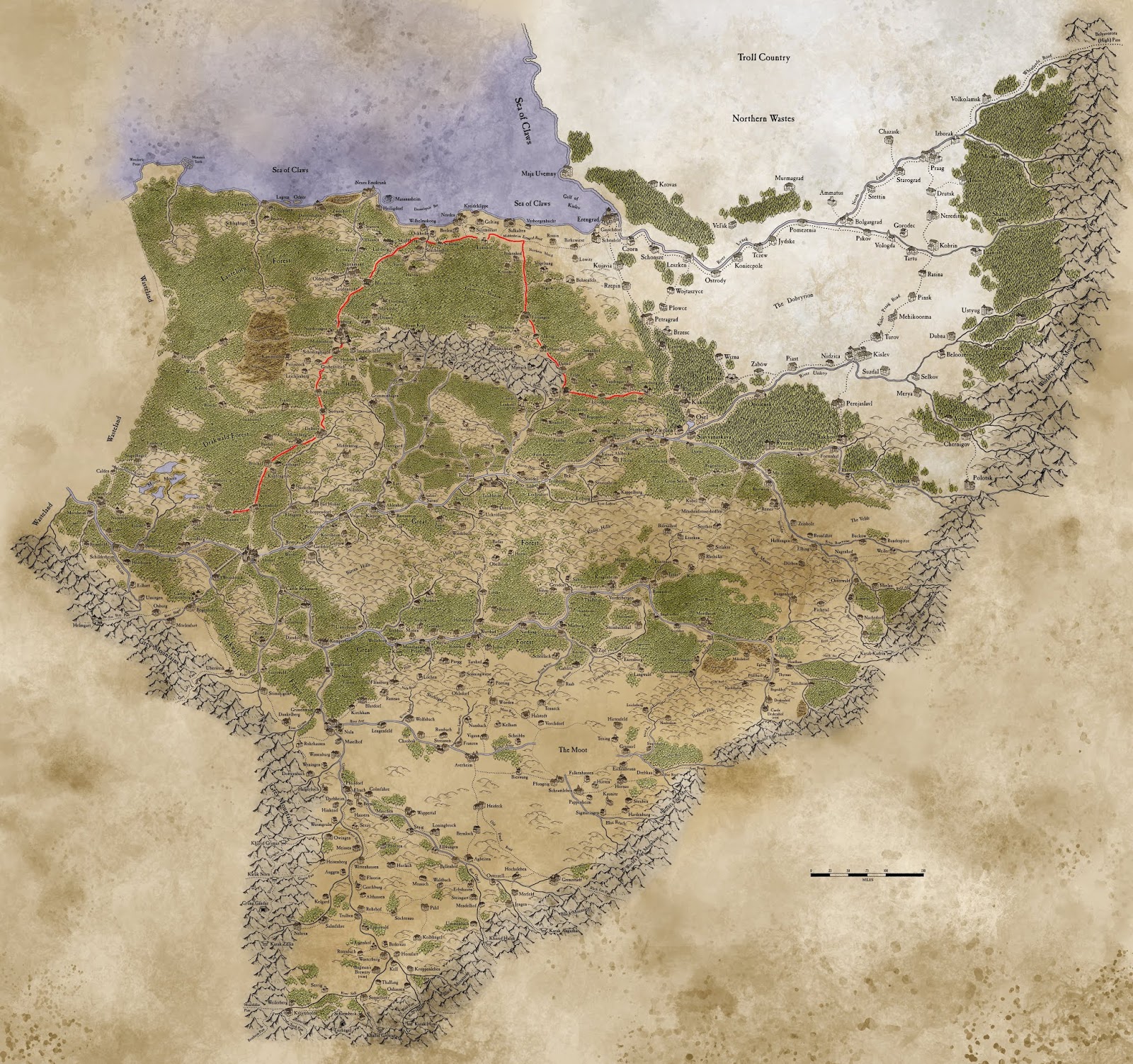
The Empire

Click for a detailed view on the road traveled so far

Petrus

Count von Pirkeimer's Captain of the Guard (as well as bastard son)

Bethold

Count von Pirkeimer's Stewart (as well as bastard son)

Father Reinprecht Teschitz

Father Remprecht Teschitz, the local Sigmarite priest at Levudaldorf, a fanatical supporter in the doctrine of one god-one nation

Professor Doktor Dirk Ekman

Professor Doktor Dirk Ekman (43), who is a colleague of Doktor Laubrich and is a senior figure at the University of Nuln. He proposes the creation of a Registrar General to collate statistics concerning public health in an attempt to discern cause and effect for illness. He is a friend of Professor Kozinstev, who suggested that the count might assist politically and financially.

Doktor Brigid Laubrich

Doktor Brigid Laubrich (39), who is here to canvass support from the count for her proposals on public health. Rather than view health as an individual issue to be dealt with by individual doctors, she sees the need for organisation and management in health matters. This needs centralised control of health programs, and the co-ordination of data and research. However, she is known to have developed a theory concerning the transmission of disease via micro-organisms in water, whilst everyone else knows that the miasma theory (transmission by vapours and smells) is correct, and she is be ridiculed constantly

Professor Axel Lommel

Professor Axel Lommel (58), is a retired physician. He is not a member of the Union and is a well-respected figure from the University of Altdorf. He is currently working with Professor Gustav Kozinstev on joint research